How to Prevent Vehicle Damage During Towing: 2026 Guide

Table of Contents
Step 1: Document Your Vehicle's Condition Before Towing
Photograph Every Angle and Existing Damage
Note Mileage, Fuel Level, and Personal Belongings
Step 2: Perform a Pre-Tow Inspection to Prevent Vehicle Damage
Check Tires, Brakes, and Steering Lock
Secure Loose Items and Disable Transport Mode
Step 3: Choose the Right Towing Equipment: Flatbed vs Wheel Lift Towing
When to Use a Tow Dolly or Wheel Lift
Why Flatbed Towing Protects AWD and EVs
Step 4: Ensure Proper Weight Distribution and Securing
Step 5: Understand Towing Insurance Coverage and Liability
What the Tow Company's Insurance Covers
What Your Own Policy May Cover
Documentation and Deadlines
Step 6: Handle EV and AWD Vehicles with Extra Care
Step 7: Conduct a Post-Tow Inspection and Address Issues
Frequently Asked Questions
Last Updated: October 4, 2026
Step 1: Document Your Vehicle's Condition Before Towing
You can prevent vehicle damage during towing by documenting your car's condition before the truck arrives. This step takes two minutes and protects you if a dispute comes up later.
Start with your phone. Set it to record the date and time.
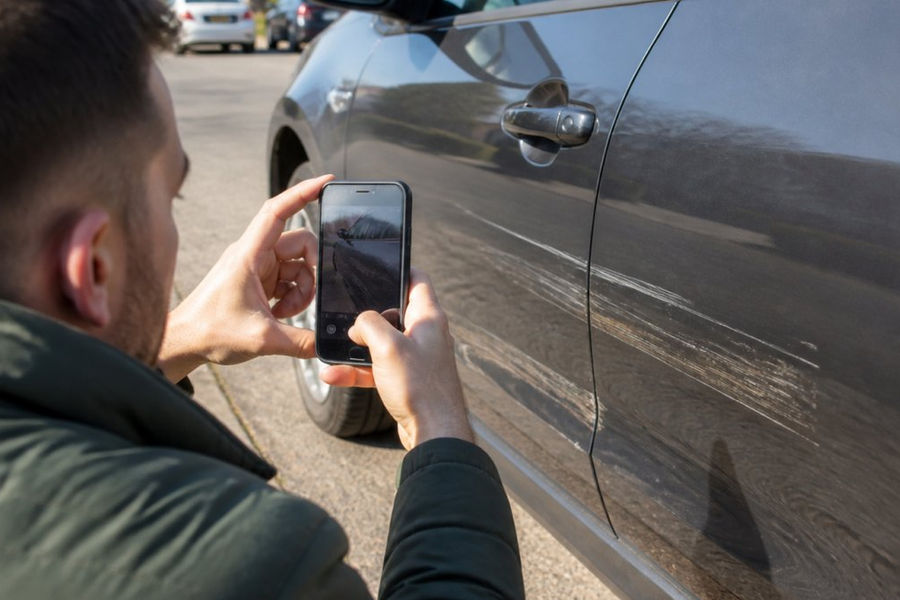
Photograph Every Angle and Existing Damage
Walk around the car once and take a photo of each side. Get the roof and the underside of the bumpers too.
Then zoom in on anything already damaged:
Scratches, dents, and cracked glass
Missing hubcaps or trim
Rust spots and paint chips
Cracked mirrors or lights
Save these photos. They are your proof.
Note Mileage, Fuel Level, and Personal Belongings
Write down the odometer reading and the fuel level. Grab your phone, wallet, garage door opener, and anything else valuable. Towing companies are not responsible for items left inside, so take them with you.
Step 2: Perform a Pre-Tow Inspection to Prevent Vehicle Damage
A quick inspection before the hook-up catches problems that cause damage mid-tow. Check these items with the driver present, before anything gets attached.
Check Tires, Brakes, and Steering Lock
Look at each tire for low pressure, bulges, or exposed cords. A flat tire that rolls onto a flatbed under its own weight can bend a rim. Check that the parking brake releases fully. If your steering column locks when the key is out, tell the driver. A locked wheel cannot be pulled straight.
Watch Out Never leave a car in gear with the parking brake on during a tow. The transmission can bind and the brake can drag, which damages both. Shift to neutral and release the brake unless the driver tells you otherwise.
Secure Loose Items and Disable Transport Mode
Empty the cupholders and glovebox. Loose items become projectiles on a tilted deck. If your car has a transport mode or tow mode, switch it off first. On many models, leaving it on keeps the suspension and brakes in a state that fights the tow.
Step 3: Choose the Right Towing Equipment: Flatbed vs Wheel Lift Towing
Flatbed towing is the safest option for most modern cars. A wheel lift or tow dolly lifts only two wheels, leaving the others to roll. That difference decides whether your drivetrain stays intact.
Here is how the main options compare:
Method | How It Works | Best For | Main Risk |
Flatbed | Whole car rides on the deck | AWD, EVs, low cars | Higher cost |
Wheel lift | Lifts two wheels, others roll | Rear-wheel-drive cars | Drive wheel damage |
Tow dolly | Front wheels on a cradle | Front-wheel-drive cars | Straps can rub paint |
When to Use a Tow Dolly or Wheel Lift
A tow dolly works for front-wheel-drive cars in good shape. The front wheels ride on the dolly and the rear wheels roll free. A wheel lift suits rear-wheel-drive cars where the drive wheels stay off the ground.
Both need care. The rolling wheels still turn, so a locked steering column or a bad wheel bearing can cause trouble.
Why Flatbed Towing Protects AWD and EVs
All-wheel drive and electric vehicles should go on a flatbed. When all four wheels touch the ground, they spin the drivetrain and can overheat a motor or transfer case. Many makers warn against dolly towing in the owner's manual.
Pro Tip Check your owner's manual before the truck arrives. It usually lists the approved towing method in a section called "recreational towing" or "emergency towing." Show that page to the driver. It settles the flatbed question in seconds.
Step 4: Ensure Proper Weight Distribution and Securing
Proper weight distribution keeps the load stable and the straps tight. A car loaded too far forward or back can shift on the deck.
Watch for these during the hook-up:
All four tires sitting flat on the deck
Straps over the tires, not the body panels
The parking brake set once the car is tied down
Safety chains crossed under the hitch
Ask the driver to re-check the straps after the first few kilometers. New straps stretch.
Step 5: Understand Towing Insurance Coverage and Liability
Towing insurance coverage and liability rules vary, so ask questions before the truck moves. In Ontario, a licensed tow operator must carry commercial liability insurance, and the Financial Services Regulatory Authority of Ontario oversees how insurers and related services operate in the province.
What the Tow Company's Insurance Covers
A tow company's commercial liability policy typically responds when the operator's negligence causes damage to your vehicle. That can include a dropped car, a strap failure, or damage from the wrong equipment. It usually does not cover pre-existing damage, mechanical failure unrelated to the tow, or items left inside the vehicle.
Ask the dispatcher three things before the truck arrives:
Is the company insured, and can they show proof of coverage?
What is the policy number and the insurer's name?
What is the process if my car is damaged during the tow?
Get the answers in writing if you can. A text message or email works. If the driver cannot produce proof of insurance at the scene, that is a red flag.
What Your Own Policy May Cover
Your own auto policy may cover towing under an endorsement or as part of your collision or comprehensive coverage. Check with your insurer before you need a tow, not after. Ask specifically whether damage caused by a tow operator is treated as a collision claim, a comprehensive claim, or a liability claim against the tow company.
If your policy has a towing endorsement, it may also reimburse you for the cost of the tow itself, up to a limit. Keep the receipt.
Documentation and Deadlines
If damage occurs, report it right away. Some claims have short deadlines, and a delay can weaken your position. Collect:
The tow company's name, phone number, and policy number
The driver's name and license plate
Photos of the damage from multiple angles
A copy of the tow receipt and any signed paperwork
For general consumer protection guidance on contracts and services, the Competition Bureau of Canada publishes plain-language resources. For more detail on your rights when you hire a service, Ontario's consumer protection resources explain what businesses must tell you up front.
Pro Tip Before the truck leaves, take a photo of the driver's license plate and the company name on the side of the truck. If a dispute arises later, that single photo identifies the exact vehicle and operator involved.
Step 6: Handle EV and AWD Vehicles with Extra Care
EVs and AWD vehicles need special handling because their drivetrains are always connected. On a dolly or wheel lift, the rolling wheels spin parts that are not meant to turn at highway speed.
Follow these rules:
Request a flatbed for any EV or AWD car
Tell the driver the make, model, and drivetrain type when you call
Point out the tow hook location if you know it
Confirm the car is in transport mode if the maker requires it
Some EVs also need the 12-volt system handled a certain way before a tow. The owner's manual spells this out.
Key Takeaway The single biggest cause of tow damage is the wrong equipment for the drivetrain. A flatbed costs a little more, but it protects the transmission, motor, and transfer case. For AWD and EVs, it is not optional.
Step 7: Conduct a Post-Tow Inspection and Address Issues
A post-tow inspection catches problems while the driver is still there. Do it before you sign anything or the truck leaves.
Walk the car the same way you did at the start. Compare it to your photos. Check:
New scratches, dents, or cracked glass
Tire damage or bent rims
Warning lights on the dash
Fluid leaks under the car
The parking brake and steering feel
If you find damage, report it right away. Take fresh photos. Then contact the company and your insurer. Reporting early matters, because some claims have short deadlines.
For more detail on your rights when you hire a service, Ontario's consumer protection resources explain what businesses must tell you up front.
Frequently Asked Questions
What should I check before my car is hooked up to a tow truck?
Before hook-up, walk around the vehicle and note any existing damage, check that tires are inflated and brakes are released, ensure the steering wheel is unlocked, and remove valuables. Confirm the tow operator uses proper equipment like flatbed or wheel lift based on your drivetrain. Ask about their insurance and hook-up procedure to prevent vehicle damage during towing.
Does flatbed towing cause less damage than wheel-lift towing?
Flatbed towing generally reduces damage risk because all four wheels are off the ground, eliminating wear on the transmission and drivetrain. Wheel-lift towing lifts only two wheels, which can strain AWD systems and low-clearance vehicles. For AWD, EVs, or luxury cars, flatbed is the safer choice. Discuss your vehicle type with the operator to pick the right method.
Are towing companies liable for damage caused during transport?
Towing companies are typically liable for damage they cause due to negligence, but liability depends on your towing insurance coverage and the company's policy. Document your vehicle's condition before the tow and report any new damage immediately. In Ontario, consumer protection laws may apply. Always ask for the company's insurance details and keep copies of all paperwork.
How can I ensure my vehicle is properly secured for long-distance towing?
For long-distance towing, verify that safety chains are crossed and attached to the chassis, wheel straps are tight, and the parking brake is released. Check that weight distribution is balanced and no load shifting occurs. Use a flatbed if possible, and confirm the operator follows a checklist. Ask about their emergency towing protocols and post-tow inspection process.
A breakdown is stressful enough without worrying about extra damage to your car. At SJ's Towing, we treat every vehicle like it is our own. Our drivers are trained to match the right equipment to your drivetrain, and we show up on time, day or night. We are a family-run team, so you get friendly, professional help at affordable rates. Get started with SJ's Towing and get a quote for safe, careful towing today.
GET A QUOTE


Comments